

AHC Maintenance Help

This site may earn a commission from merchant affiliate
links, including eBay, Amazon, Skimlinks, and others.

Joined
Jan 31, 2017
Threads
4
Messages
23
Location
Tennessee
So I am still pretty new to the 100 series, and am learning a great deal as I go. I have a FSM for the correct year ('05 LX), and Techstream.

Next on my list is to figure out and maintain the AHC system. As far as maintenance in the past for this vehicle, it looks like it was dealer maintained but I really don't know what if anything they did for the AHC system.

The readings in the picture are with me out of the vehicle, and close to a full tank of gas. My initial questions are:

1. The FSM seems to indicate that adjusting the torsion bars will correct the left to right difference shown on the screen between the FR and FL height control sensors. However, this is confusing because I have read several threads where people try to raise the front of the vehicle with tb adjustment, only to have the sensors bring the vehicle back down after driving. Why then would tb adjustment level the front from side to side without the sensors bringing it back to the original height?

2. Relating to the 1st question, does the -0.2 on the FL mean the driver side is too high or too low? I ask because the FSM states:

Inspect and adjust the height control sensor to the neutral
position.
(1) Read the value of height control sensor on the LEXUS
hand−held tester.
Standard value:
Actual vehicle height ± 5 mm (0.20 in.)
HINT:
(Example)
When the measurement value of the front vehicle height is 85.0
mm (3.35 in.), the actual value of height control sensor is −2.3
mm (−0.09 in.).

In the FSM example, 82.7 was the spec height for the front, and measured it was 85. It seems that in this example a negative number means the indicated side is too high??

3. As I understand it, the only things I can do for the rear height sensor and pressure sensor are to buy coils and/or spacers. Is this correct?

4. I know the steering angle is way outta whack. I'll have to figure that out next.


Variables: The fluid needs to be flushed, and 1 rear shock is seeping fluid. 8 marks currently on the graduation test.
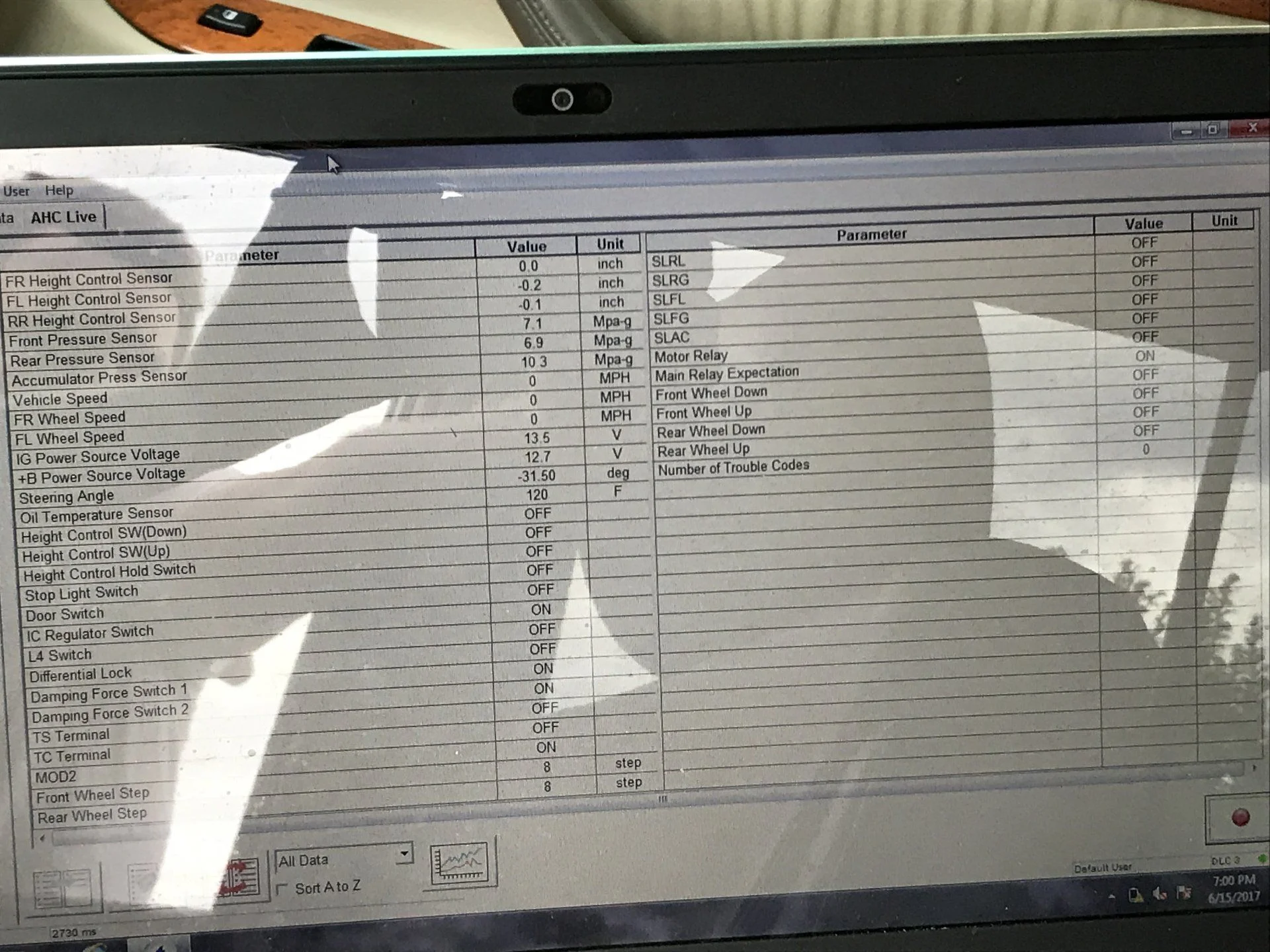
IMG_2709.webp
 
bump for assistance.
 
1) TB's, in a simple explanation when adjusted independently - will only bring each front corner closer together or further away around sensor position height 0. When adjusted in unison - they will increase or reduce the amount of weight/pressure seen by the hydraulic system.

2) too low, tighten the TB clockwise 1/2 - 1 turn or so to get the spring to take more weight and bring the vehicle closer to 0. Its pretty hard to hit it dead even both sides, usually i drive around for a little to settle the suspension and then pull straight in for 20 ft or so on a flat / level piece of road / parking lot - coast to a stop. anything .1 in the computer i dont really chase - i make sure the measurement to the fender is the same side to side.

3) get more pressure off the front hydraulics (tighten clockwise the tbs in unison after you even it out), flush the fluid ( i have a diy video on this), and do a pressure test - remove the oil temperature sensor when doing the rear lift from L to N. All these will help. If your still overshooting new springs - either new oem (or oem with 1" spacer) if you arent going to load her down with alot and your very close in pressure, or king springs if your going to add a bunch of stuff to the vehicle.

If you get king springs, you will most likely have to adjust the ahc height sensor in the rear, so it thinks its lower than it really is, thus making the system extend the shock further, and this will get your pressure up where it needs to be - as it will be too low otherwise. Its a free lift of sorts.

4) you should be able to reset the steering angle with techstream

5) Seeping shocks may resolve themselves once you flush the system. Excessive pressure in the system can cause shocks to weep as well and once the pressures are corrected it goes away / gets better. Your pressures seem pretty spot on but im not sure how much adjusting you did prior. 8 grads is the minimum, you may see a small increase after flushing, maybe not.

6) search - everything has been covered. Paddo posts are a great resource.
 
Last edited:
wow ive never seen techstream. its just software or ... it must require some kind of proprietary interface cable.

where did you get techstream ?

oh and, does your AHC seem to be working ? Just curious as to if you think something is wrong or just trying to find any issues that the eye cant see
 
wow ive never seen techstream. its just software or ... it must require some kind of proprietary interface cable.

where did you get techstream ?

oh and, does your AHC seem to be working ? Just curious as to if you think something is wrong or just trying to find any issues that the eye cant see

2018 TOYOTA TECHSTREAM TIS MINI OEM VCI LEXUS SCION DIAGNOSTIC SCANNER TOOL KIT | eBay

I'm sure you can get it somewhere cheaper, but the service this guy provided to guide me through a few installation hiccups was worth it to me. Very responsive, and was recommended on a Tundra forum.

AHC system is working, but the vehicle is new to me and I am unsure of any maintenance performed in the past on the AHC system. I originally got techstream to view AHC pressures, as I understand from reading on Mud that they are usually high if no adjustments have been done in the past. The numbers shown in the picture are without me touching anything yet. My thought is that I would do all I could to adjust pressures and heights, change the fluid, etc. to give me a baseline going forward. I am mostly concerned with my leaky rear shock and marginal graduation test (7 marks is the min. per FSM).

@Lucky Strike is correct in that Paddo posts contain a wealth of AHC info. Strike's video of an AHC fluid flush may be helpful to you if you decide to flush fluid and haven't rolled under the truck to find the necessary components yet.
 
bump for assistance.
There were lots of Qs in your first post! Think of front and rear heights being measured along the center line of the vehicle and theses heights are dictated by the height sensor Normal null points. Think of the front heights measured at the wheel wells as a roll up or down around the centerline. Alternatively, the lift or drop of the hydraulic actuators moving equally up or down is superimposed over the adjustable mechanical heights set by the torsion bars rate or the rear coils lift.
From a previous post somewhere, sometime.
To set cross level all you need is a tape measure and 30mm socket; don't touch the height sensors whilst setting cross level at the risk of chasing your tail and becoming increasingly frustrated. Height sensor feedback follows the upper arm to chassis displacement and can be nulled pretty much anywhere so it's much better (per FSM and experience) to physically set the actual cross height then adjust the sensor to read 0 or as near 0 as practical at your selected N height. Adjusting cross level via sensor feedback only works if you're sensors are perfectly aligned as if it just rolled out of the factory.
Vehicle OFF and set cross level, ideally splitting the difference by lowering the high side and raising the lower side. Then adjust overall height via sensors if necessary and lastly adjust pressure with equal turns on both TBs so as to not undo the cross level you just set.
 
Just to update this thread: I set cross level according to Paddo above. Then, I dialed in the front pressure (which wasn't too far off to begin with) and this also helped the rear pressure figure.

Next, I flushed via Paddo's method. I improved from 7-8 marks to 10 marks on the graduation test.

Next, I plan to replace the rear shock that is still seeping. I was considering doing globes at ~7 marks, but now that I am up to 10 I feel a little better. I'll probably do some rear coil spacers as well.
 
Further update: Pressure readings were 6.5 F/ 6.5 R back in June (see above post). Height sensor readings were: FR -0.0; FL -0.1; RR -0.0. Cross level was within ~1/8 inch.

Recently, I replaced the leaking rear shock and added Slee 30mm spacers to the rear. I also flushed the fluid again.

My current readings without any further TB adjustment and after installing spacers and shocks are now as follows: 6.8 F/ 5.8 R. Sensor readings are now all -0.1.

It seems the spacers really helped with the rear pressure, and slightly raised the front pressure. Somehow, I am now off on cross level by around 1/4 inch. I'm thinking of tinkering with the cross level, then turning the TBs about a half turn to see where I end up.

Thanks again to Paddos posts.
 
Back
Top Bottom