

More confusing operating temperature info.

This site may earn a commission from merchant affiliate
links, including eBay, Amazon, Skimlinks, and others.

cruiserdan

SupportingVendor Emeritus
Moderator
Mod Emeritus
Joined
Mar 27, 2003
Threads
159
Messages
27,213
Location
Prepping for Canyonlands
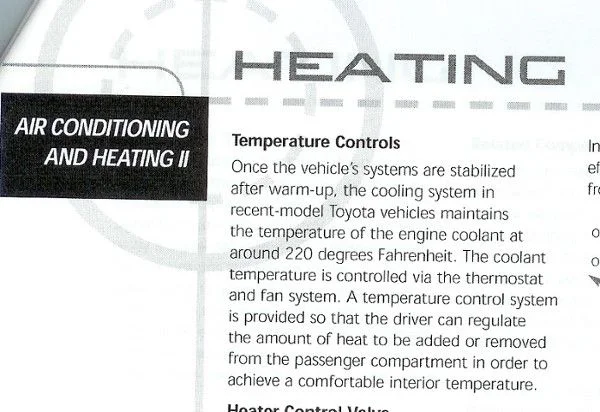
Whilst taking some re-certification tests in order to retain my status as a Master Parts Manager I ran accross this tidbit of information. I scanned the page since you may not believe what I found:
scan.webp
 
Are they saying they want the coolant at a constant 220?

Seems high, my gauge is painted at about 175 on the raventai mod temp gauge guide.
 
KliersLC said:
Whats the publishing date on the book?

Maybe recent is more recent than say, 1997...


It's quite recent since it discusses the scroll-type A/C compressor utilized in the 2004 and up Prius.

The 220 degree "target" does appear to dove-tail in with the A/C cut-off/cut-in temperatures of the 80. I wish that "recent" had been better defined.
 
94landcruiser said:
Are they saying they want the coolant at a constant 220?


More like "about 220" but yes, I think that is what it says.
 
I imagine it depends on where the measure is taken. I have heard that manufacturers shoot for 220 before this, like in the mid '90's. Doesn't really jive with a 195 degree thermostat, though, as that's where the hottest water should be and if the cooling system is up to par the thermostat should open and close regularly- meaning that without the t-stat the system would run colder than 195, everything else being equal.

-Spike
 
Some of the oil sludging problems have been traced to engine temps that are too cool, so this may be part of that solution. Water boils at 212 without pressurization.

DougM
 
IdahoDoug said:
Some of the oil sludging problems have been traced to engine temps that are too cool, so this may be part of that solution. Water boils at 212 without pressurization.

DougM

To clarify further, I believe the belief was the sluding was caused by localized hot spotting and the oil experiencing to rapid of a drop as it went from the hot head to the cooler block. The "solution" was to make the block hotter. :eek:

While 220 does seem a bit high, I believe and continue to believe that operating temps of 200-215F are well within the normal range for the 80 with a properly functioning cooling system.
 
Agree. Me likes hot oil as it burns off the moisture whose presence is far more damaging than almost anything in oil, as well as the fuel blowby that is probably #2 on the list. Good oil that can take the heat and proper change intervals complete the personal preference list.

DougM
 
I still don't understand why some think that water temp is indicative of oil temp. I was always told oil temp was noticably higher from contacting surfaces like the cylinder walls and bearing surfaces. If you want hotter oil just pull the oil cooler from the system.

I still don't think this applies to our trucks as there is no way my truck runs that hot in the winter with the current thermostat in there even when the fan clutch was junk.
 
Coolant Temps - some thought on 'high' temps

By 'recent', I'd bet this is 'as in very'. The higher you can maintain the operating temps, the lower the fuel consumption and wear. The key is to be able to 'hold' it there without even higher spikes. The newer the vehicle the more closely regulated are operating temps. The trend in the new cars is to make 100C the operating temp, and narrowing the control limits of that temp. For emissions, oil longevity, fuel economy and wear, a +/-5C (+/-8F) variance will be better than something like our 80's at 202F +/- 22F

IMO and research, you will see the control limits of cooling get really narrow because of CAFE, EPA, and warrantee. There is no real downside to hotter temps, other than the limits of the cooling system as a whole. This will also trend the demise of VC mechanical fans in favor of electro-mechanical on/off fans, or electrics.

The biggest issue on light trucks and SUV market is duty cycles in extreme conditions. When folks want to tow their boats with A/C blowing cold, you need a lot of heat managementcapacity. The result can be overcapacity the other 90% of driving. Some consider this to be great, that the truck never 'overheats'. In actuality, a 80 running sustained 220F isn't overheating either, and has less sludge in the crankcase because of it.

What we will see in SUV/light duty truck market is immediate changes to more precise control of engine temperatures, and the limits of operating temp rise to 100C or even more. I suspect and predict that cooling sytems on combustion engines will eventually be 'dual' systems. The block temps will hover at 100C, and head temps will get targetted to run a lot cooler than that, maybe 70C or less. The research has already indicated that 100C is optimal block temp, but that cooler head temps result in more available timing advance.

What offsets this climb in engine operating temps is the other side of the equation - reductions in the safety margin of overheating of glycol based coolants.

Bottom line: Higher and narrower variance in engine temps will yield good results in fuel economy, oil moisture blow off, wear, and emissions. Expect this trend in higher + stricter control of heat management to be the key to newer cars, and can be retrofit to the older ones, us 80 owners included

Scott Justusson
94 FZJ80 Supercharged
Retrofitting heat managment project 101

 
Last edited:
SUMOTOY said:
In actuality, a 80 running sustained 220F isn't overheating either, and has less sludge in the crankcase because of it.

So what I am getting out of this is to stop being concerned about the extra heat from my supercharger as long as my cooling system is in great shape.
Forget the aux fan, hood scoop and other mods.
 
This is consistent with the design operating temps of the Jeep 4.0L inline six circa 1997.

An upgraded cooling system (tow package) is desirable to avoid playing in those upper temp limits.
 
Last edited:
Romer said:
So what I am getting out of this is to stop being concerned about the extra heat from my supercharger as long as my cooling system is in great shape.
Forget the aux fan, hood scoop and other mods.

Thats a big jump Ken. I say that 220F is within the normal operating parameter of the 80. And the reason Mr. T gave a dead guage is that the variance of 'normal' operating temp is 45 degrees F, so the guage *needs* to be dead.

I have concerns about #6 cylinder blowing headgaskets because of heat buildup at the back of the head, where you have EGR heat, and low airflow. I have concerns that under extreme conditions the engine bay temp can cause a spiral of rising temps that can't be controlled by stock components.

I have confidence that more consistent (read: less variance) of normal operating temps above or at the boiling point of water will yield known benefits in fuel consumption, engine wear, and extend oil viscosity index.

Stop being concerned? Not in summary judgement. I certainly would have very little concern about proper heat management allowing more precise control of the engine operating temps in the 212-220 range.

Short answer: You can't assume a supercharger can't overheat a properly functioning cooling system on an 80 in an extreme heat environment. I define extreme heat environment as towing and/or altitude and/or high speed and/or sand and/or high ambient temps and/or high engine bay temps.

HTH

Scott Justusson
 
landtank said:
quite a few are throwing out the fact that higher temps yield better fuel economy and longer life.

So what does that mean in real numbers. How many more MPGs and how many more thousands of miles will be added?

There's a chart that shows wear and GPH fuel consumption floating around this forum in several threads. IIRC the fuel consumption 180 -210 was around 7-10% less at higher temp and the wear was about 40% less. Fuel consumption doesn't impress me much, but oil properties do.

SJ
 
Better fuel economy and longer life, maybe I should put a heater in the engine bay:D
 
Hotter engine bay = well cooked burrito!
 
SUMOTOY said:
There's a chart that shows wear and GPH fuel consumption floating around this forum in several threads. IIRC the fuel consumption 180 -210 was around 7-10% less at higher temp and the wear was about 40% less. Fuel consumption doesn't impress me much, but oil properties do.

SJ


I don't drive my truck that much in the summer anymore but will start in earnest come winter. So I'll definitely be always around 185* and run the truck either on the highway at 75-80 or around town so I should expect very poor mileage @ 13.5 mpg and extreme wear. I should do probably 3 oil changes through the winter so that will be 3 blackstone lab reports to show this wear on the engine.

Personally I think all this benefit from high temp is BS, but we'll see.
 
landtank said:
I don't drive my truck that much in the summer anymore but will start in earnest come winter. So I'll definitely be always around 185* and run the truck either on the highway at 75-80 or around town so I should expect very poor mileage @ 13.5 mpg and extreme wear. I should do probably 3 oil changes through the winter so that will be 3 blackstone lab reports to show this wear on the engine.

Personally I think all this benefit from high temp is BS, but we'll see.
Could be, here's how I justified it in my my garage Rick.

10% fuel economy by just increasing to 100c operating temps, and maybe another 10% by ditching the largest engine load (VC mechanical fan), the gains could be significant. And at 3buck a gallon, gives a roi pretty quickly.

Here's my math
Part IV mod cost = ~300USD
17mpg * 20gal fill = 340 miles at $60 fillup
20mpg * 20gal fill = 400 miles at $60 fillup

Savings = $9 per 400 miles
300/9 = 33 400 mile trips
13,000 mile ROI

That's a 6 month ROI for me.

Even if I see 'actual' half the projected improvement, I've got an ROI of less than a year.

Scott Justusson
 
Back
Top Bottom